
YIMBY Action is About to Endorse a Candidate for California Governor. Here’s How We Do It.
Electable? Good on the issues? All of the above?

Last week, we held our annual YIMBY Gala in San Francisco. And, as California is about to hold our primary election for governor, we were pleased to host San Jose Mayor Matt Mahan and former Congressmember Katie Porter. (Philanthropist Tom Steyer wanted to be there, but had a conflict.)
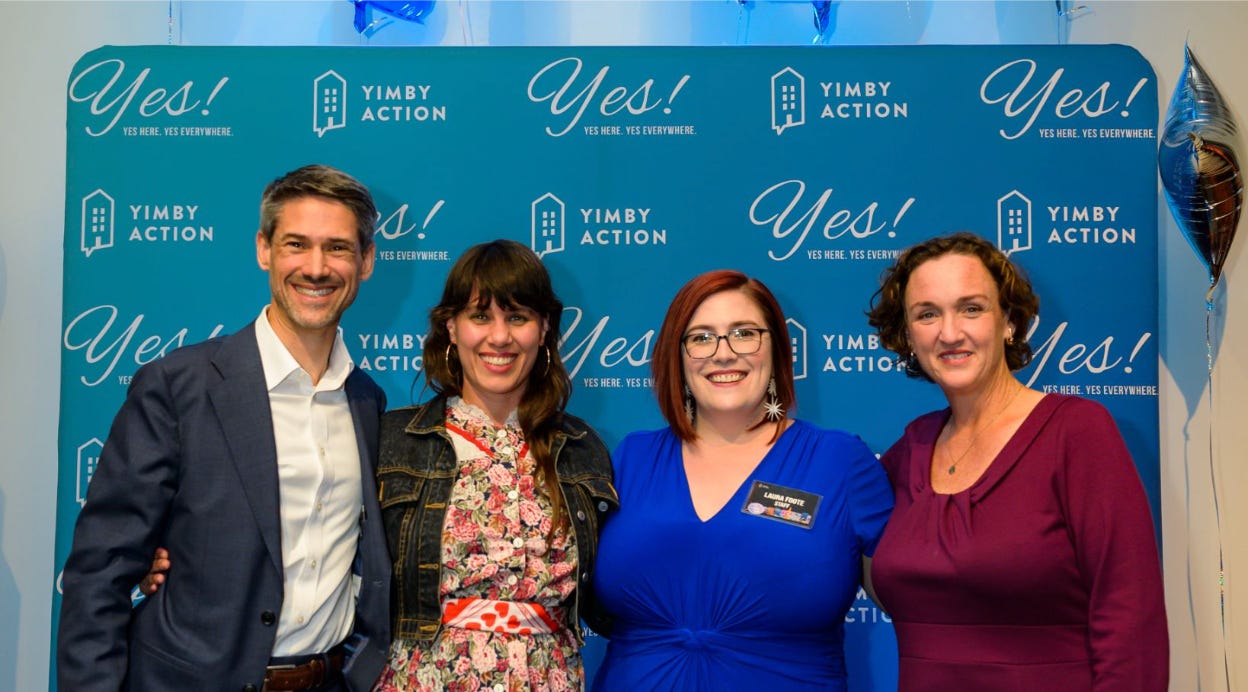
In the very near future, YIMBY Action will be endorsing someone for Governor. I can’t say who it is yet, because we haven’t decided, but I do want to talk about how we make our endorsements, since people always have a LOT of thoughts. Every organization has a different playbook, and so I thought it would be interesting to walk through ours.
Insider Versus Outsider
Some organizations focus on an Insider Strategy, which has the primary goal of maintaining access to elected officials. It’s the “pick a winner” strategy. If you endorsed a loser, the winner is not likely to return your phone calls (or so the thinking goes).
People whose power is based on donating money often follow this insider-focused approach. They attempt to forecast who will win and throw their weight behind that candidate, building the relationship and making them feel obliged to follow their policy recommendations. Ideology plays a much smaller role, because as one political science paper put it, “no one wants to back a loser.”
On the other extreme, there are organizations that don’t care at all about viability. They’re so rooted in their status at Outsider Critic of the System that they prioritize ideological alignment over all else. If nobody is good enough, then too bad for the candidates, because no endorsement will be issued. For example, the LA chapter of the Democratic Socialists of America recently decided they wouldn’t endorse a mayoral candidate for just that reason.1
In other words, the Insider wants to be able to pick up the phone; the Outsider wants to be able to throw stones. Those are two ends of the spectrum, and most folks are somewhere in between.
Our Endorsement Strategy
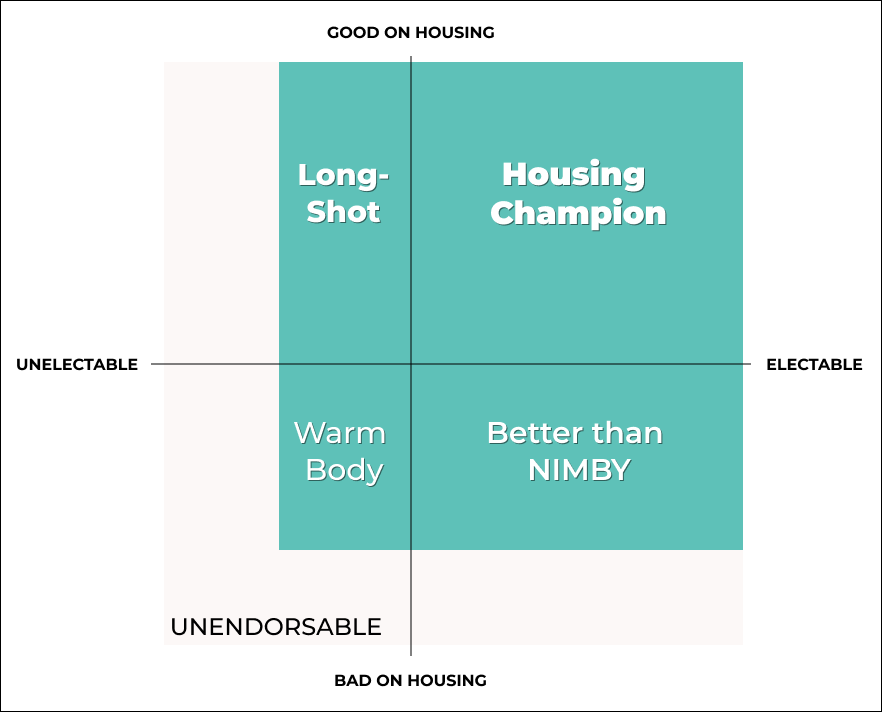
The TLDR is that we want to endorse a candidate who 1) meets a minimum threshold of viability; and 2) aligns with us more than any other minimally-viable candidate.
Viability
Instead of fixating too much on a candidate’s chances relative to the rest of the field, we think about it as a simple binary. We ask “Is it possible - even remotely - that this candidate could win?” If the answer is “yes,” we’ll consider them.
But, of course, telling the difference between a Long-Shot and a It’s-Not-Going-To-Happen is something people argue over. Figuring that out is one of the most difficult conversations an organization can have.2 Ultimately, it’s a judgement call, but a basic heuristic is to ask whether they are raising money, have a kitchen cabinet helping them run, and are on track to get more than 10% of the vote. If you can check all those boxes, they’re probably minimally viable.
One important caveat is that viability changes depending on what kind of election it is. Primaries are different from generals, and ranked-choice elections3 are different from first-past-the-post ones.
In primaries and ranked-choice elections, the viability threshold can be pretty low. Formats with two rounds give you two shots at endorsements; ranked-choice elections even allow you to put a Never Going to Happen at the top of your ballot without losing too much influence, so long as you list other candidates. On the other hand, there are often only two viable candidates in general elections and first-past-the-post elections. As a reality-based movement, it’s important not to be delusional about candidate viability.
So for example, in the primary race for California governor, there are a lot of non-viable candidates. (Tony Thurmond, it’s time to call it.)
Issue Alignment
Once candidates have met the Minimum Viability Threshold (MVT), we then grade them on issue alignment. A good endorsement process both pulls out information from the candidates and moves the entire field to adopt more pro-housing stances. Candidate interviews, debates and candidate questionnaires all give candidates opportunities to demonstrate their pro-housing credentials.
Getting candidates in front of members helps them see and experience that there are real voters who care about an issue. Candidate interviews give you a chance to build rapport with candidates you may not have known before. Any time a candidate speaks in front of your members, it’s an opportunity to crystalize a real connection and show that your organization is REAL. They should feel the value of your group joining their trenchcoat.
In addition to interviews, parties and forums, we also do candidate questionnaires. A good questionnaire gives you an accurate assessment of their priorities, but doesn’t bog a candidate down in a level of detail that isn’t important. You can read the questions we asked the California candidates here. You’ll notice our survey is short4 and relevant to the actual job.
You can dig into the responses to our candidate questionnaire for California Governor here in a less than gorgeous spreadsheet.5 You’ll notice that the top five candidates decided to answer, ie. Tom Steyer, Katie Porter, Matt Mahan, Eric Swalwell, and Xavier Becerra. This means these candidates actively sought our endorsement, engaged substantively with our ideas, and publicly pinned themselves down on several key policies. Even before we endorse, this is how our process moves the entire field in the right direction.
Another key point: Our questionnaires are open-book tests. Candidates should cheat on them! Which is to say, they often ask a YIMBY Action member or a Chapter Lead to get coffee and give them the “right” answers. This is called listening and learning, and is encouraged. Every coffee we get with someone running for office is a victory in and of itself, even if we don’t endorse them in a given race.
Candidates do not hold fixed, immutable positions.6 So, the endorsement process isn’t an attempt to unearth a politician’s True Beliefs.™ Instead, it’s a part of changing their minds and demonstrating there is a voting bloc that will support them if they take up our positions on housing. If we can explain to somebody running for city council why something arcane like single-stair reform matters, we’re more than halfway to getting something passed into law.
Common Tough Outcomes
Sometimes deciding who to endorse is pretty easy — for example, when there is one viable candidate who is way better than the rest. Hurray, argument over. But frequently it’s hard. Here are two examples of where endorsements can be particularly tough to make.
Everyone Kinda Sucks
A common, tragic situation, especially for new YIMBY Action chapters, is that all the candidates are mediocre. And my advice boils down to: Tough shit. Endorse a Warm Body if you have to. Do not fall into the purity test trap where you resist telling folks who is the lesser of two evils because you don’t want to be blamed for their crappy track record.
Building power over time frequently means endorsing the lesser of two NIMBYs. Elections are sometimes harm-minimization events. Many districts will have candidates who all are varying degrees of bad. It’s our job to dig in with a good endorsement process to find the marginal differences and give voters clarity about their actual choice, not wish for a better field. It’s often the case that the candidate who won’t bother to return your email is worse than the one who engages in good faith but writes back something that’s half-garbage.
Building a voting bloc requires giving election guidance that more and more people go to year after year. It’s an iterative game and a muscle that you strengthen over time.
Everyone Kinda Doesn’t Suck
Alternatively, sometimes you’re blessed with several decent candidates, which can makes the arguments even more vicious somehow! The California Governor’s race is hard for a completely wonderful reason: Several of the candidates are actually pretty good! And seeking YIMBY Action’s endorsement! Hurray!
Comparing apples and pineapples is a frustrating game. Our process involves getting our cohort of volunteer activist chapter Leads to look over the questionnaires and interviews and debates, and muddle through a genuinely hard decision. With over 30 chapters in California, we have 123 Leads who got together last weekend. So what’s the chatter?
Matt Mahan has opposed major housing bills, but now has a great housing platform. He fought for local exemptions in the big Transit-Oriented Development bill last year (SB 79), but he did get San Jose to build more. He’s shown how cities can reduce fees on housing and still see good results on both their budgets and housing production.
Katie Porter had some great lines at our event about how Orange County needs to get its shit together on housing production. She has a consumer advocacy perspective on how the housing shortage is eating away at Californians’ pocketbooks. And she seems eager to crackdown on departments under her control who could be enforcing housing law. But she also expresses hesitancy about cutting fees and doesn’t seem to have the policy chops of other candidates.
Tom Steyer has been a vocal champion recently for big housing bills like SB 79, and has put real pressure on the environmental movement to get on the right side of housing production. His outsider status means he has little tolerance for all the stakeholders who list out reasons why building housing is so challenging. And he’s not scared to support policies like Prop 13 reform, which is one of the root causes of our housing shortage. But many question if he has enough experience to be effective.
And, popping up a bit late in the game, Xavier Becerra just submitted a quite impressive questionnaire. He’s got good ideas for increasing enforcement efforts and demonstrates he understands what a Governor could actually do on day one to increase housing production. But he’s been quiet on housing up until now, so some question if he will put in the work to push for the reforms that we need.
Do we hold it against Mahan that his previous track record is mixed? Do we question whether Steyer has the right experience to actually move a bureaucracy? Do we ask if Katie Porter is demonstrating enough commitment to housing production over other concerns? Do we worry that Becerra will really make housing a top priority? These are all questions worth considering.
Our volunteer Chapter Leads have argued, voted, and now made a recommendation to the membership. And tomorrow (today if you’re reading this Monday morning) YIMBY Action ballots drop for all California members who’ll make the final call… We’ll keep you posted!
There are also kooky groups out there that seem to revel in backing non-viable candidates.
In a movement, these are often excruciating calls. Non-viable candidates are sometimes your friends or your long-time volunteers. They may be lovely, ambitious people who have gotten a bit ahead of themselves.
Feel free to fill in the comments section on your favorite hyper-niche opinion about the optimal voting system.
Many organizations have extremely long questionnaires that, while they may pin candidates down, risk the top candidates collectively boycotting them. They also risk masking rather than revealing what your organization really cares about.
Swalwell’s answers are still available to read, though he is not being considered.
That’s a feature, not a bug of democracy.
When should we expect an announcement on this?
What's the voting method? I like how AURA, in Austin, does it (or did it when I was involved): members only vote, ranked choice with top winner as the endorsed candidate while anyone with >50% are named preferred candidates.