

In a recent quote that frustrated YIMBYs everywhere, Strong Towns founder Chuck Marohn said, “For years, housing debates have leaned on a simple promise: build enough homes, and prices will fall. It’s an appealing idea. Technical problem, technical fix. What’s striking is how often that promise now collides with reality.” Pointing to a small boomlet of supply-skeptical academic studies as well as recent comments by the president, Marohn argues that the American political system will never allow enough housing to be built to solve our crisis. As he explained further on the Strong Towns blog, “we don’t live in a housing system designed to deliver affordability through falling prices.” The real problem, he said, was that we have “embedded housing in a national financial system that depends on price appreciation to function.”
He eventually claims that pursuing state reform signals a broken theory of change. Marohn writes:
When local reformers push up against a system designed to protect asset values — and that system refuses to give — the natural instinct is to apply more force. When deregulation and new construction don’t deliver affordability quickly enough, the answer isn’t to slow down and reconsider the model. It’s to reach for more authority. State preemption. Federal mandates. Larger subsidies. Broader enforcement. More power, applied from farther away, with less tolerance for places that don’t perform as expected.
As YIMBY Action Board Chair, and someone who has been engaging with Marohn’s work for almost a decade, I find this confusing.1 Not because I disagree that we’ve built a system premised on perpetual real estate appreciation; instead, it’s his characterization of state-level reforms as a sign that regulatory reform isn’t working. State-level housing reform isn’t a failure mode, it’s how we enable local change. In my view, it’s also supported by the Strong Towns framework that Marohn has spent so many years developing.
Local Government Was Not Designed to Produce Housing Abundance
Marohn’s critique would be valid if housing advocates had actually implemented comprehensive local reforms and they’d failed.2 But we haven’t escalated to state-level reforms because local ones failed — we’ve pursued state-level action because local institutions are biased against reforms in the first place.
Local land use institutions enshrine vetocracy. This means the only people who get what they want are the ones that want to block, stymie, and slow down housing production. Politicians are swayed by the loudest voices in the room. At the local level, those voices are neither random nor especially representative of a community. I agree that our system is not designed to deliver affordability. However, this includes actors at the local level. Local constraints on housing production are the proximal, binding constraint on supply.

Insisting that housing advocates contest policy at only the local level is tantamount to requiring us all to fist fight with one arm tied behind our backs. And to put a stake in the ground on this, yes, there is a fight to be had. Marohn argues that we exist in a system designed to reject affordability. I agree. Where we diverge is that I see the gatekeepers of that system as local institutions designed to exclude, extract, and ensure change is always an uphill battle.
State Legislation Requires Local Support
If I’m reading Marohn correctly, he feels that state-level housing reform is something that’s done to local communities. That implies, however, that state policy is set in a vacuum and that local communities are indivisible wholes. But when Marohn argues for the primacy of local control in housing policy, he’s not defending the right of self-determination for a community from technocratic interlopers — he’s unintentionally defending the status quo. When we pursue state-wide legalization of missing middle housing (like what’s described in this excellent Strong Towns policy guide) we’re not overriding local control, we’re enabling local action.
The California ADU story illustrates exactly how this works in practice. In California, it took successive waves of state legislation to effectively legalize ADU development. All this was necessary because local governments can turn state law into dead letters through malicious compliance.3
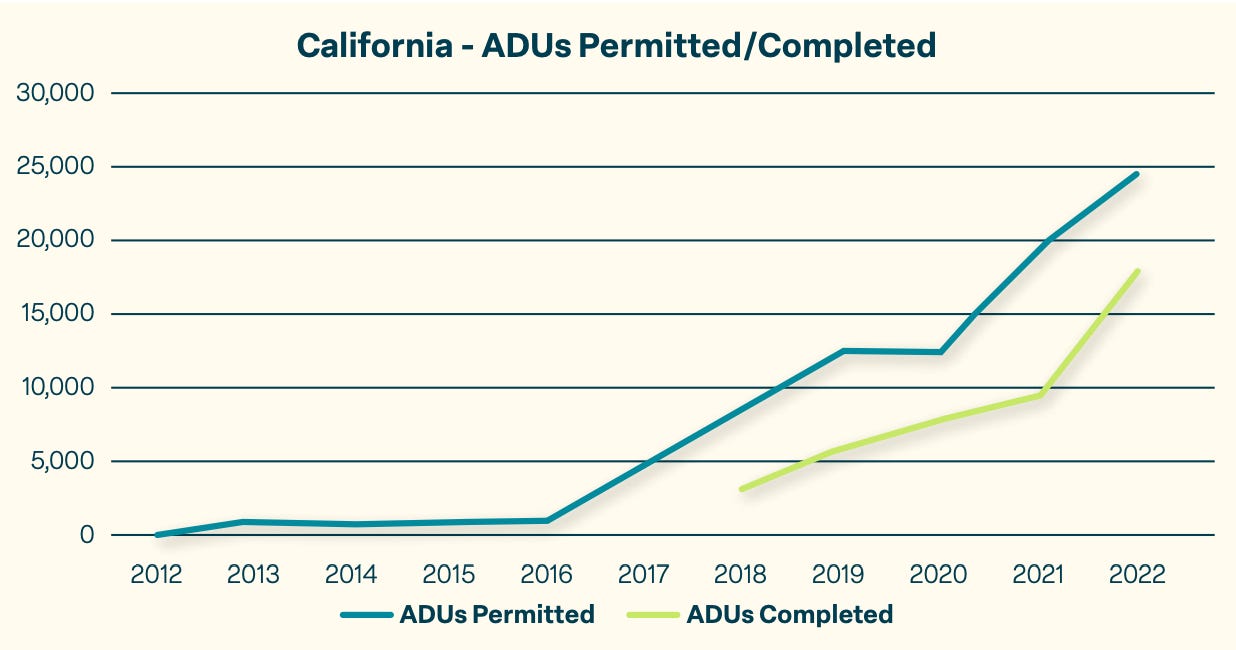
The reason state-level ADU legislation eventually worked is because local advocates fully supported the spirit of the reforms. They monitored their own local governments, identified legal gaps for state policymakers to fill with follow-up legislation, and gave local policymakers the political support they needed to eventually embrace the reforms. The assumption buried in Marohn’s defense of local control is that communities are unitary actors. They aren’t. State reform doesn’t override the community — it shifts whose preferences within that community get to count.
We Should Take the Knowledge Problem Seriously
Marohn has expressed his theoretical concern about state action in terms of knowledge problems. Higher levels of government don’t know the conditions on the ground, and so local policy makers are best positioned to make decisions with respect to local policy. And there are great examples that show his point, like the federal highway system bulldozing neighborhoods. So, there’s something to the fear that federal (and even state) policy can amount to a bull in a china shop and we should be wary of bad intent and second order effects.
And yet…
Marohn asks us to give weight to local policy knowledge; I’d ask him to give the same consideration to local political expertise.
When local housing advocates (including Strong Towns Local Conversations) go to the state level for support, it’s because they’ve made the calculation that state capitols will give their ideas a fairer hearing than city halls. If local knowledge means anything, shouldn’t it include the judgment of local housing advocates that state intervention is necessary to overcome local NIMBY capture? Our understanding of local knowledge has to include the judgment of people who have worked within their own local institutions and concluded that those institutions need outside help to reform.
The Conversation Remains Ongoing
Marohn makes many other points in the piece I’m quoting here. I disagree with a great many of them, but I’m making a deliberate choice to focus on the specific issue of state reform here today. As always, I stand ready to be corrected on either substance or interpretation. And, if Marohn cares to go deeper on the role of financial markets or our respective theories of change, I’ll be happy to find the time.
True Story: I have a fond memory of Chuck explaining the concept of extend and pretend to me at a conference in 2016.
Reasonable people could disagree on different definitions of “comprehensive”; for my tastes, I like Japanese-style zoning as a frame of reference.
Or just outright break state law. And not in a “we disagree on the interpretation of some statute” kind of way. I mean in a “knowingly violate the law on the theory that no one will notice” kind of way.
I want to clarify one thing, because it seems to keep getting reframed.
My argument is not that supply doesn’t matter. It’s not that state reform is illegitimate. It’s not that local institutions are perfect.
The question I’m raising is structural.
Even if we successfully reform zoning everywhere.
Even if we build at historically unprecedented rates.
What happens when prices start to fall in a system built on price appreciation?
Housing is not just shelter. It is collateral. It underwrites pensions, banks, municipal finance, and household balance sheets. When prices flatten, capital pulls back. When prices decline meaningfully, political and financial pressure mounts to stabilize them.
If the system intervenes to prevent sustained price correction — as it repeatedly has — then supply alone cannot deliver durable affordability at scale.
That’s the tension.
If we want to make housing broadly affordable, we have to grapple with that political economy, not just the regulatory layer.
Jeff, I invite you to look deeper into some of your words.
As you wrote, "I see the gatekeepers of that system as local institutions designed to exclude, extract, and ensure change is always an uphill battle."
Those gatekeepers are humans. They have incentives, and they have blind spots, just like us. Chuck has done plenty of work to identify them.
It is a disservice to the good work of YIMBY organizations to marginalize these people as acting irrationally. They are acting rationally according to the incentives presented to them by big system players in both the Federal government and global financial investors.
To give power to the states, who are outsiders to the housing system, so they can overrule the actions of smaller players not only does not address the incentives of the system, but also sets a very bad precedence.
Take it from someone who lives in Canada, whose cities are creatures of the province (in our vocab, province = state). You don't want your state to have such powers over localities.
My city has not had a new hospital built since 1988, despite our population doubling from 808,000 in 1988 to 1,589,000 today. Not because our city didn't want one. We had a site picked out that would serve neighbourhoods who otherwise would have to drive 20-30 minutes to the nearest hospital.
However, partly because the city did not vote for the provincial party currently in charge, and partly to save costs, the provincial government axed the hospital plans. The province operates on income taxes, so as long as it isn't tanking the economy or angering its political base outside the city, it has no incentive to build a new hospital.
What happens if your state later changes its mind and decides it will revert back to the status quo? You will give it the power to intervene in local affairs, after all, so it has the authority to do so. Think about the possible ways the state can reverse its decision. The federal government, financial investors, municipalities, banks, and constituents all want the status quo because the incentives have not been changed, and they can apply considerable pressure to the state government and reverse the progress you made. What then?
If the financial incentives of the housing system don't change, there will be a limit where state preemption can no longer hold back the political will of everyone in the housing system.