
Scott Wiener Just Proposed The Most Straightforward Pro-Housing Idea Ever
Just pay cities to build housing. Seriously.

Last week, Scott Wiener, the California state senator running for congress in San Francisco, announced his housing platform.
As you might expect from one of the nation’s most prominent YIMBY elected officials, there’s a lot to love, including a mixed-income social housing program to build four million homes; doubling the federal affordable housing tax credit to produce three million affordable homes; expanding housing vouchers, tenant protections, and worker protections; and making housing faster and cheaper to build by creating a Pro-Housing Incentive Fund to incentivize local governments to allow new homes.1
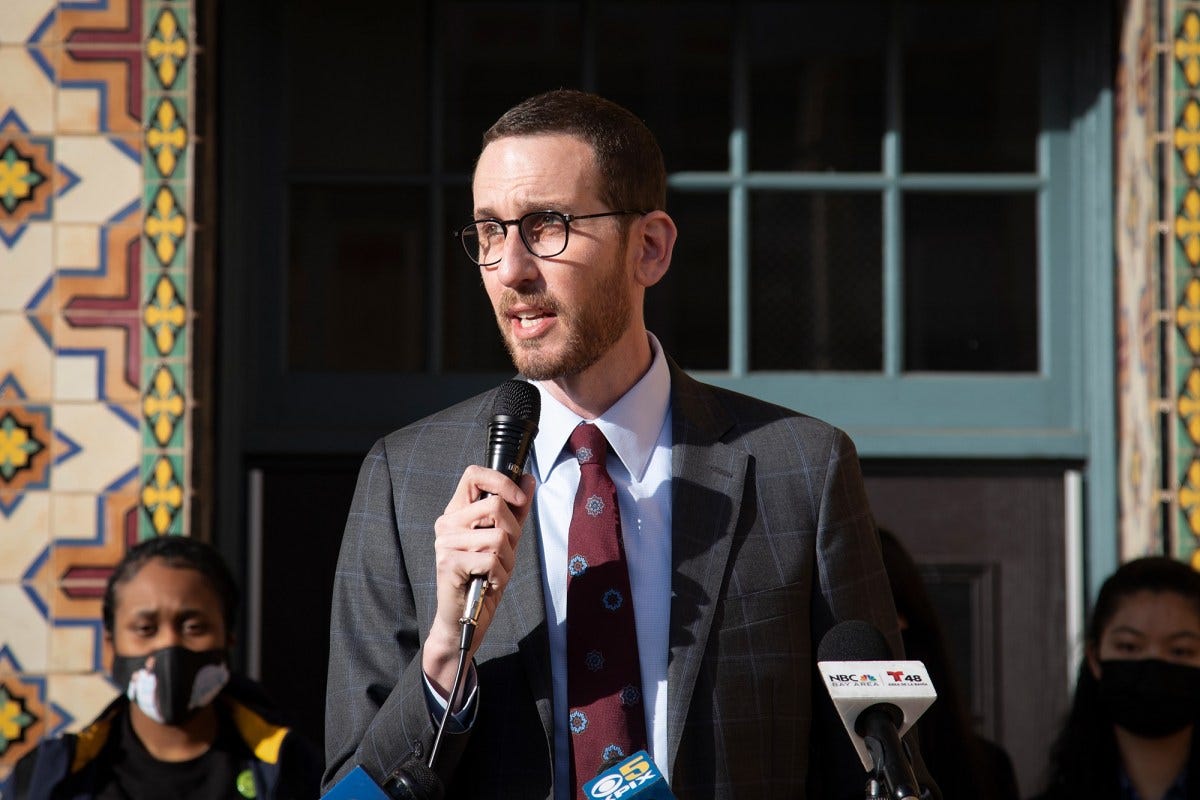
I think that any of these would be substantive pro-housing reforms that could move the needle nationally, but I want to focus on one in particular: the Pro-Housing Incentive Fund. Mostly because it’s an idea that Sonja Trauss (Executive Director of our sister organization YIMBY Law) and I have been pushing for a while, and I’m thrilled Scott is going to run with it.
To lower the cost of building housing across the country, the federal government must start to incentivize local and state jurisdictions to enact prohousing policies. In Congress, I will fight to create a Prohousing Incentive Fund to reward jurisdictions that are actually getting housing built. The jurisdictions can invest the funding directly into infrastructure, water, sewer, or any of the many needs that growing communities have. By taking this outcomes-based approach and rewarding housing production over policy changes, we can focus on supporting approaches that are yielding results.
Under Wiener’s proposal, the federal government would incentivize local governments to allow new housing by a straight-forward method. Paying them.
For every new unit of housing that a municipality certifies for occupancy, the federal government would transfer $10,000 to that city’s general fund. Whether it’s a new backyard cottage, a new unit of multi-family affordable, a new town home, whatever. Every new unit would mean another $10,000. Critically, this money would be unrestricted, meaning the local government could use it for whatever purpose that local officials thought would be most important.
In our ongoing conversation, Strong Towns’ Chuck Marohn argues that local governments know best what their needs are and aren’t being set up for success, often because of federal incentives. As a result, every city has some neglected piece of infrastructure, and they often erroneously see a proposal for a new apartment complex as just another problem they’re going to have to deal with. The Pro-Housing Incentive Fund provides resources along with something the federal government rarely gives: flexibility.2
Transfers to a local government’s general fund gives them straight-up cash to address those needs, without the paperwork of applying for competitive grants or trying to shape their needs into restrictive federal programs. Maybe they want to experiment with a new social housing program. Maybe they need a new park. Maybe it’s just repaving Main Street. Whatever!
As background, it’s worth understanding that the assumption in most local government hearings is that new housing and new people are a burden on the existing community. This is either an exaggeration or just flat wrong. I’m not going to spend time trying to convince you, dear reader, that new people and the tax revenue they bring are Good Actually. But it is true that cities and towns are acutely attentive to the costs of new residents rather than the benefits. And the infrastructure costs are not zero — new housing does require spending on things like sewer lines, roads, bus service, schools, and public safety, just to name a few. So why shouldn’t we give local governments money to increase the level of service in growing communities?
Currently, many cities try to assuage this fear of increased costs from new residents by taxing new housing with impact fees, transfer taxes or other one-time fees. It’s a practice that rests on the assumption that new housing — and new people — have a net negative impact on local budgets that needs to be offset. Like most bad ideas from California, impact fees are increasingly popular across the country, as local governments try to grab some cash up front to defray the expected long term costs of those horrible new residents.
The first objection I’ve heard to Wiener’s proposal is that it would mean cities would allow people to build a bunch of housing we don’t need in places where it shouldn’t be. If we think about this for more than approximately three seconds, the idea is laughably unlikely. As it turns out it costs a lot more than $10,000 to build a housing unit, so the only thing that would get built is housing that either a market rate developer or subsidized affordable builder determined was valuable enough to build anyway. The $10,000 isn’t enough to fund something that couldn’t have happened on its own — but it’s enough to incentivize a local government to get out of the way. There’s not a problem in allowing people to build housing in places where there is no existing incentive to build housing.
The second objection I’ve heard to this idea is that it would be expensive. But on the scale of “federal programs that could avert a national housing shortage,” it’s hella cheap. According to the Department of Housing and Urban Development, there were 1.4 million new units of housing built in the United States in 2025. Let’s say we doubled housing production with this incentive. That would mean the yearly cost of this program would be $28 billion dollars — a small fraction of the $7.1 trillion the federal government spent last year. By comparison, the Department of Defense spent $849.8 billion last year, or two billion dollars a day.3 So we could radically transform the US housing market for the cost of two weeks of military spending. Not bad! And this money would be spent by local governments to improve communities in unexpected ways across the country.
Cost isn’t just measured in dollars, though. The Pro-Housing Incentive Fund would be structured as a simple, outcomes-based program. It’s meant to have low administrative overhead for both federal and local authorities. Because this program directly rewards cities for tangible outcomes, it does a great job at preserving state capacity.

Incentive-based policymaking is a great concept, but there are a lot of ways you can miss the mark. You can go awry by incentivizing an input rather than an outcome, such as rewarding cities for pro-housing policies rather than outcomes. Sonja registered her concerns about that recently. A crafty city could, for example, pass a transfer tax at the same time as an upzoning, resulting in negligible housing production while checking the box of having passed a pro-housing policy. There’s a lot more to be said about how much work it is to create a bureaucracy that has to analyze and evaluate policies, but I’ll leave it there.
Another way you can go awry in incentive-based policymaking is by incorrectly identifying whether something will actually be an incentive. For example, some have proposed denying LIHTC funding to cities that fail to meet housing production targets. This won’t work because it threatens NIMBY cities with a good time, telling them, “If you don’t allow more market-rate housing to be built, then you won’t get money to build low-income housing.” A rich NIMBY place like Beverly Hills would take you up on that offer in a heartbeat.
By contrast, Wiener’s proposal simply asks, “What do we want more of?” and dangles a carrot out. With the right incentives, many local governments will figure out what their problems are — and solve them.
Just making this explicit — these proposals are targeting at increasing both affordable housing and market rate housing. So, contrary to some recent stories, I think it shows that many YIMBYs like Wiener and I have always been in favor of a both/and approach.
Currently, the federal government transfers large amounts of money to state and local governments. According to one analysis, in 2024 federal grants to state and local governments totaled $1.1 trillion, with Medicaid making up the largest share at $618 billion. Transfers for the highway system were $53 billion and rental assistance payments were $34 billion. Almost all of this spending is restricted to particular purposes.
Not counting the Iran war.
Excellent post Laura, thanks. I read Scott's Housing Plan with delight. Big, audacious, smart - classic Scott Wiener. I would especially love to see this idea go through, ideally with zero hooks, gotchas or pointless incentives.
Good to see "pay for results" gaining from the old "pay for policy reform" (which often never delivers).