
Zohran Mamdani Is Surrounding Himself With YIMBYs
Here’s why leftists should be happy about it.

YIMBYism is ideologically agnostic. There are many ways — and reasons — to be pro-housing. The Republican governor of North Dakota is a YIMBY. So is the centrist Democratic mayor of San Francisco and the left-wing Democrat Alexandria Ocasio-Cortez. YIMBYs are environmentalists, libertarians, and members of unions and chambers of commerce. And you don’t have to publicly identify as a YIMBY for us to celebrate you as a pro-housing leader.
So while that means it might not be surprising when a prominent left-wing leader embraces YIMBYism, it is still the case that it is big news when it happens. New York’s incoming mayor Zohran Mamdani is rapidly becoming one of the most interesting elected officials around the country on housing issues. By combining his support for rent control with his support for rezoning, he resonated with many New Yorkers.
As one writer in City Journal pointed out:
The results reflect the dwindling political clout of the small-homeowner coalition that once bolstered Mayors Edward Koch, Rudolph Giuliani, and Michael Bloomberg. That group, spread over outlying parts of the outer boroughs, is more suburban in lifestyle, has high auto ownership, and is less well-served by public transit. Its waning voting power reflects the substantially increased population in areas of Northern Brooklyn and western Queens rezoned in the Giuliani and Bloomberg years [...] Thus, the city’s governing Democratic political class has evolved from a posture that might be described as ‘Left-NIMBYism’ to ‘Left-YIMBYism.
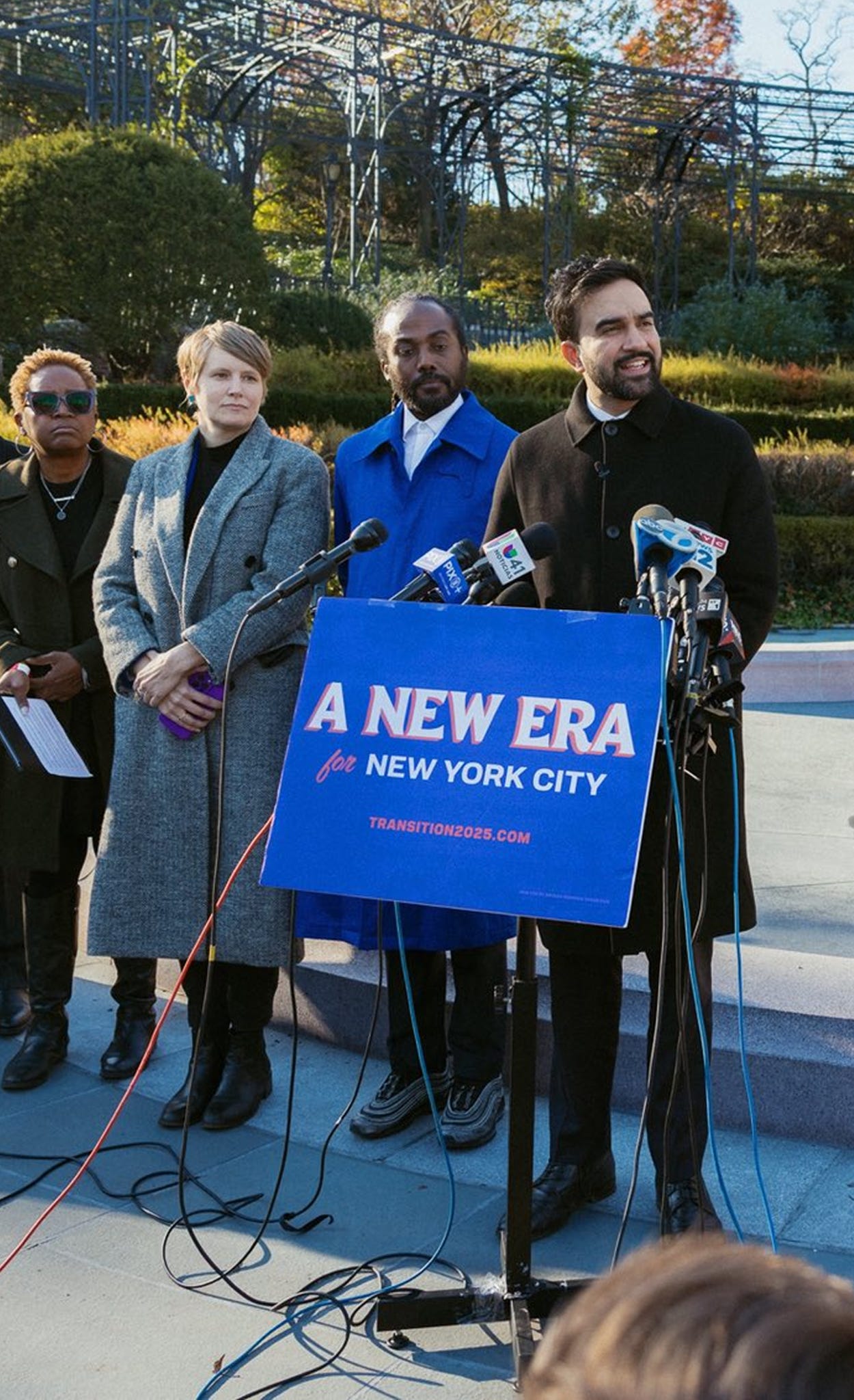
If all politics is personnel, then at least as he prepares to take office, Mamdani is ensuring that YIMBY perspectives will influence policy in the new administration. Mamdani recently announced the names of more than 400 people who will help with his transition to city hall. Among them are a committee of 17 people who will advise the mayor on housing, who include prominent YIMBYs Annemarie Gray, the executive director of Open New York and Paul Williams, the executive director of the Center for Public Enterprise,
But not everyone is into it. Some of Twitter’s most anti-YIMBY leftists who had a very different reaction to the transition committee:
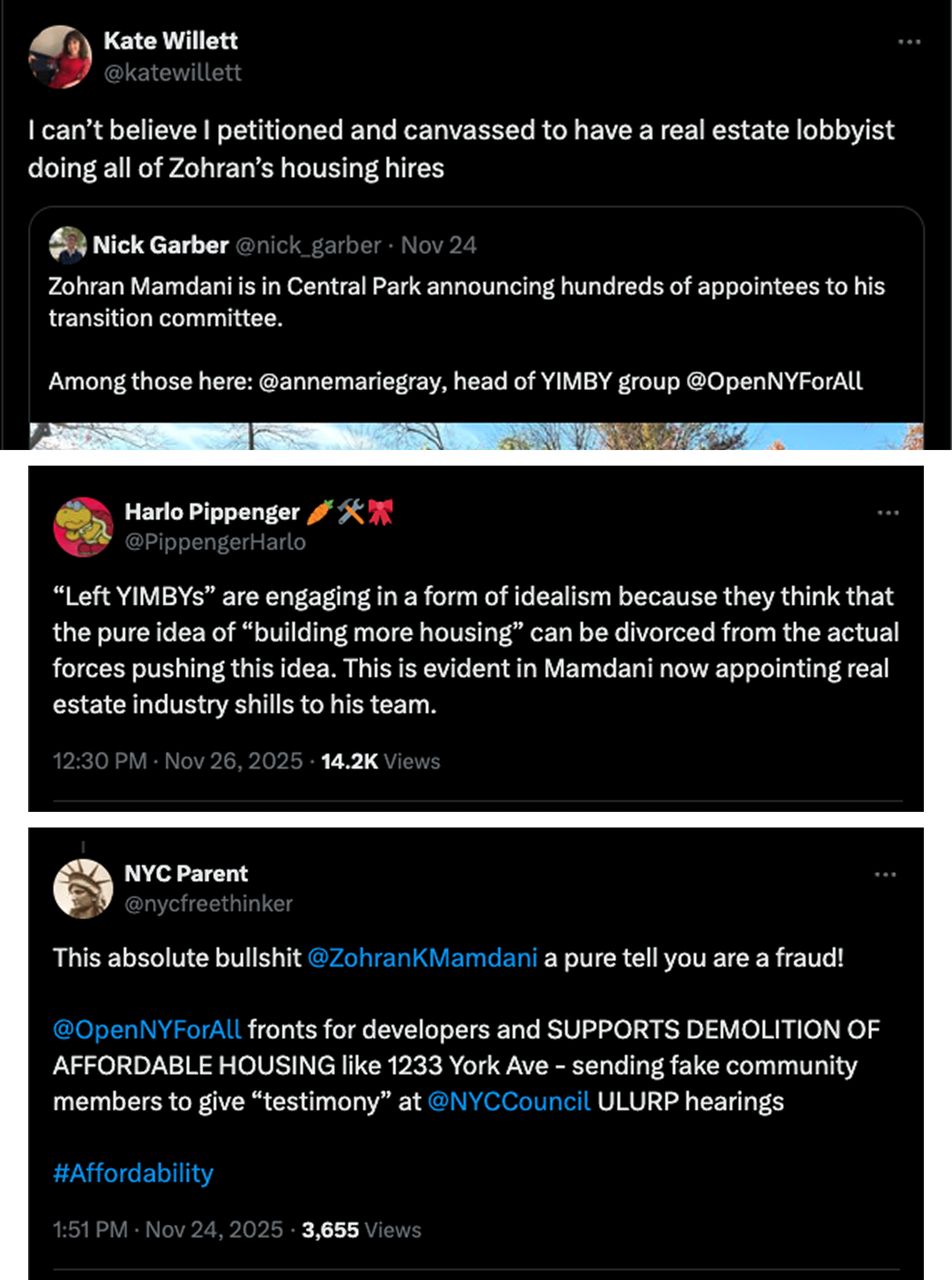
I’d be frustrated too if a candidate whom I supported for a lot of other reasons was opposed to me on an issue I care a lot about. And while Mamdani was increasingly signaling he was pro-housing as the election went on, I have empathy for folks who feel whiplash.
But, Mamdani represents the increasing popularity of left-YIMBYism. The ideological ice that said that YIMBYism and leftism can’t go together is cracking. Even the socialist magazine Jacobin recognizes it. While the loudest parts of the left discourse have long been hostile to market rate housing (including San Francisco, New York, and in cities in other countries too) the reality is that things are finally opening up.
There may be good theoretical reasons in the Left Canon that dictate that Left-YIMBY Cannot Be A Thing… Yes? No?I don’t know. Who cares? All models are wrong, some models are useful. The practical politics are clear: left-YIMBYs win elections in left-leaning cities with unaffordable housing.
Part of why this was possible is that Andrew Cuomo was a comic-book villain who literally did not care about achieving a more affordable New York City. Not everyone is blessed with such an opponent. What continues to be challenging for other candidates in blue cities is that there are a range of policies that have the stated goal of creating affordability, and it is often hard to get folks who agree on the goal of affordability to agree on the means to that end.
Political coalition development is often a product of its environment. Mamdani had the luxury of being able to pull together a left-YIMBYs coalition more easily than most. Compare him to the Los Angeles Mayor Karen Bass, who continues to court the still dominant left-NIMBY coalition, and San Francisco’s progressives who sadly continue to triple down on their opposition to the family zoning plan.
Mamdani was able to pull in a much wider range of supporters than progressives often court in city-wide elections. More often, there is a visibly sane moderate who slurps up pro-housing, pro-small business, and good-government oriented organizations. This shrinks the path for progressives, who end up courting anti-change progressives who prioritize community input, and create the classic left-NIMBY coalition, to the great frustration of pro-housing progressives. For example, in the San Francisco race to replace Nancy Pelosi, trans-youth-supporting Scott Wiener will run as a “moderate” YIMBY, while protect-our-cars Connie Chan will run as a “progressive” NIMBY. (And everyone will call everyone else a hypocrite.)
During the campaign, Mamdani embraced an abundance agenda, rightly pointing out that the cost of living was far too high for everything from housing to halal food trucks. Frankly, it’s been exciting to watch over the past few years as DSA members like Mamdani have embraced YIMBYism. The truth is that NIMBY zoning laws hold back progressive goals like affordable housing, social housing, community land trusts, and efforts at racial integration. (You can’t build Vienna-style social housing without being allowed to build housing.) And, despite what some left-NIMBYs seem to think, supply and demand are real. It’s not left-wing to deny it, and it’s not right-wing to accept it.
What’s most exciting (or threatening, depending on your perspective) about Mamdani is that he is inspirational. Leftist politicians in districts where left-NIMBYism has been the standard operating procedure for years should examine whether a left-YIMBY path is plausible in their race. Not everyone in their coalition will make the leap, but ambitious politicians who have made that gamble have often found success in broadening their appeal.
I'm glad that Zohran seems to be positioning himself as a YIMBY. I'm worried, though, specifically about rent control in New York City. From an economic point of view it's clear that rent control is a force against housing construction. And it's so strong in NYC already - according to some sources roughly half of NYC residents are under rent control. So I'm just worried that a stance of "YIMBY but also supports rent control" is going to net out to be "NIMBY" because strengthening rent control could easily outweigh everything else he does, in terms of the housing market.
We'll see. Fingers crossed that NYC starts building more housing. It would be great for there to be a progressive pro-housing success story that others could emulate.
Minor note, you mis-spelled "canon" as "cannon".