
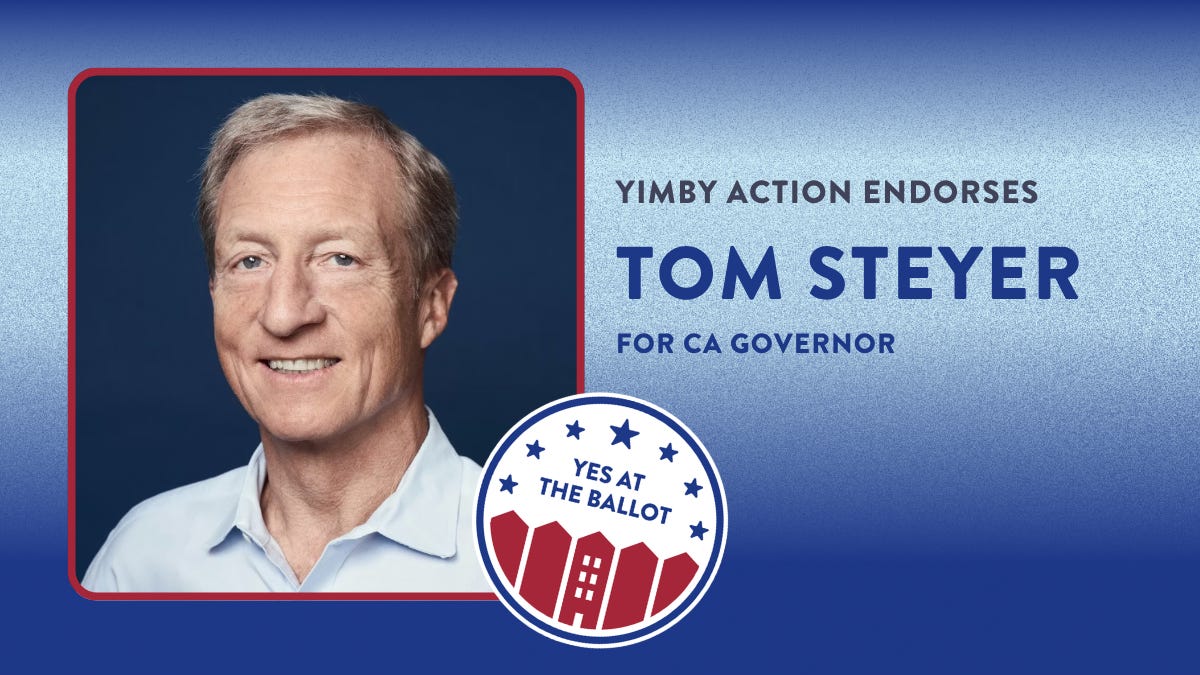
YIMBY Action Endorsed Tom Steyer for California Governor.
Here’s why.

Last week, I wrote about how YIMBY Action decides on endorsements. As an example, I talked about our ongoing endorsement process for the primary election for California governor, which will be held on June 2.
As of Monday, the cat — or the candidate — is out of the bag. YIMBY Action is endorsing Tom Steyer for California governor.
So now that the news is live, I wanted to revisit our post about endorsements, and talk more about how we made our decision.
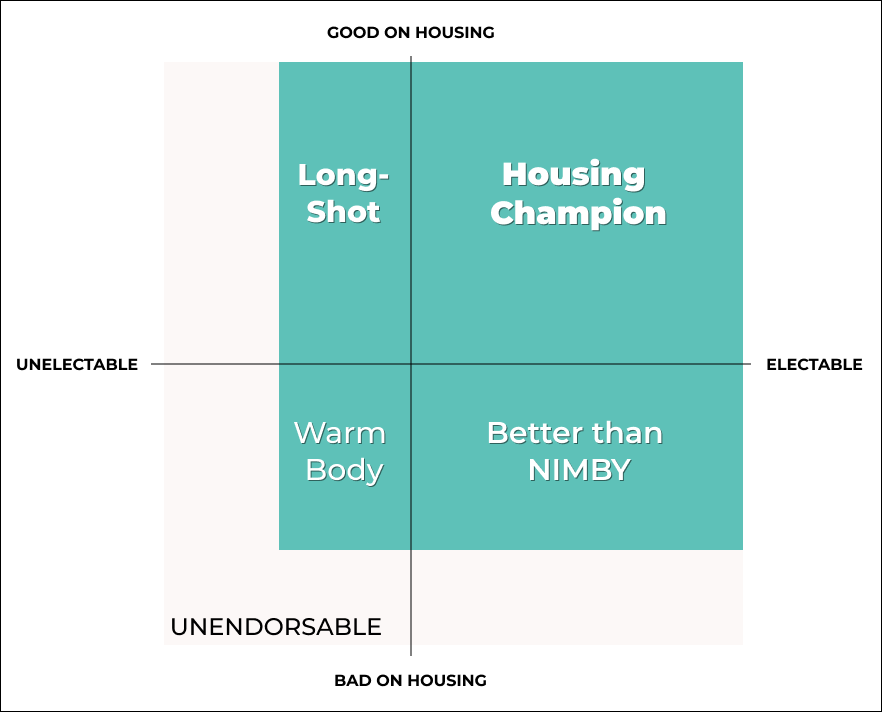
As we said last time: “The TLDR is that we want to endorse a candidate who 1) meets a minimum threshold of viability; and 2) aligns with us more than any other minimally-viable candidate.”
So let’s turn to the governor’s race in California to see how it worked.
At the time we sent out the questionnaire, we estimated that there were seven electorally viable candidates. The two Republicans are explicitly anti-production, so would not be under consideration. That left us with five candidates: Steyer, as well as former California Attorney General Xavier Becerra, San Jose Mayor Matt Mahan, former Congressmember Katie Porter, and Congressmember Eric Swalwell.1
Among the candidates who did not meet our electability threshold were Superintendent of Public Instruction Tony Thurmond, former Los Angeles Mayor Antonio Villaraigosa, and former Controller Betty Yee. We also did early interviews with some candidates who dropped out, including former Speaker Toni Atkins.
In April, Swalwell dropped out of the race following multiple allegations of sexual assault, leaving four viable candidates for us to sort through.2
That left us with three high-quality questionnaire responses (and one late submission from Becerra).
Steyer was good on just about every issue we asked him about. Among his campaign proposals is a pledge to build one million new homes in the state in four years. It’s an ambitious target, but we like ambition!

Steyer understands that local barriers to dense housing contribute to our housing shortage, and he listed several pro-housing bills in the state legislature that he has supported. Just about the only area where there is some disagreement between Steyer and our members is the question of sprawl. He tends to oppose it on environmental grounds, while many YIMBYs believe that it needs to be part of the solution. The crux of it is a debate (even within the YIMBY movement) about whether we can get infill housing built fast enough.
As an aside, since we endorsed Steyer, my inbox has been full of developers telling me we made a mistake. Liam Dillon covered this tension in Politico recently, writing about how many developers are skeptical of Steyer, even as he is the most pro-development candidate. I think some of it is about sprawl and some of it is that Steyer, while quite rich, is too left-wing for their taste.

Turning to Mahan, many of those homebuilders who might be lining up behind Steyer are supporting him instead. That caused a tough choice for us. But while we like where Mahan is on many of the issues, it wasn’t clear to us if his time as mayor of San Jose was an asset or liability. Mahan clearly empathizes with city governments. Does that mean he knows how to overcome their NIMBYism? Or does that mean he would too often accept their excuses? Ultimately, we thought that Steyer offered the better path to tackling housing at the state level, while Mahan was too focused on the kind of development-by-development negotiations that have helped create the housing shortage.
As for Porter, she really engaged with us, and in the process, moved to more sophisticated pro-housing positions. What seemed to hurt her the most, however, was a conversation she had onstage with Mahan at the YIMBY Gala. Mahan was talking about San Jose having lowered the fees it charges new housing development. For YIMBYs, this is one of the lowest-hanging fruits — you shouldn’t put fees on something you want (housing) to pay for something you also want (subsidized housing). But Porter clearly didn’t get it. “Wasn’t it bad for your city budget to cut fees?” she asked him. If you were there, I’m not sure I was able to hide on my face what I felt about her question.
Mahan gave a solid answer, based on his experience as a Mayor, that revenue did not fall. But his answer also demonstrated he also had the same perspective problem as Porter did: More concern for city budgets than for average Californians.3
Finally, Becerra was late to the game, and that has made YIMBYs skeptical of his positions. For a while, we weren’t sure if he even wanted our endorsement, since housing has not been one of his priority issues and he ignored our emails. His questionnaire finally came in as YIMBY Action Member Ballots were going out. And just yesterday, he released his housing platform, which Dillon shaded by saying “It’s in depth and written by someone who understands the various debates in Sacramento. (If anyone wants to tell me who wrote it, I’m all ears!).” Zing.
So what was the point of all that?
First of all, it’s that we are excited to have endorsed Steyer.
In addition to that, endorsements are about finding the best candidate and mobilizing excitement to support them. They’re also about influencing the entire field. Our endorsement process helped move the whole field towards housing abundance, pinning candidates down on substantive policy commitments that will stand up throughout the rest of the campaign.
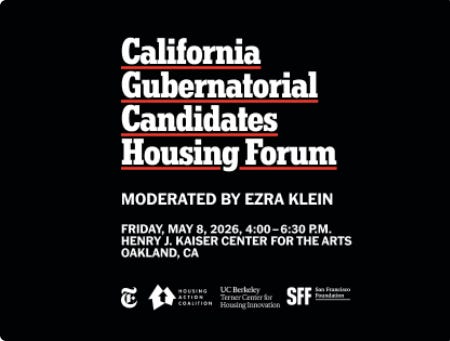
Tonight, I’ll be with our friends, the Housing Action Coalition, at their gubernatorial debate, and while I’ll be there to cheer for Steyer, I’m excited that other candidates have an incentive to “prove us wrong” and commit to even bolder stances on housing production. Please feel free to throw me in that briar patch. Executive Director of HAC Corey Smith has convinced me to live-tweet tonight, so I’ll keep you posted!
Although I bet that if the questionnaires were going out today, Mahan would no longer be considered viable, since he is now polling around four percent.
What about the two major Republicans in the race? YIMBY Action may be ideologically promiscuous, but we aren’t idiots. They may be viable in the primary, but neither are pro-housing and made it clear they didn’t want our endorsement.
This also brings up another idea I might write about later: the persistent belief that new housing doesn’t pay for itself and drags down municipal finances.
I appreciate Steyer's newfound emphasis on housing, but I have real concerns over how quickly Mahan was dismissed, for reasons that don't appear to go beyond "vibes."
Mahan is clearly and obviously more focused on housing, while Steyer has great plans but a million competing priorities. How sure are we that he'll prioritize housing over, say, healthcare or taxes when obstacles inevitably crop up?
Furthermore, the focus for YIMBYs at this point should be removing barriers to housing rather than expansion of upzoning. We've done the hard zoning reform; we now have (barely) sufficient zoned area in populated cities to allow lots of infill housing. At this point, the main barrier to housing is fees, forced IZ, and labor requirements. Mahan is obviously better than Steyer on each of those.
But, my most substantive concern at this point is the dismissal of Mahan *simply for being from a city government*. Is it the position of YIMBY Action that city government officials are inherently unqualified because they *might* empathize with cities against statewide pushes for housing? That was an incredibly disappointing line to read. If you have evidence that Mahan would support local control over state mandates, show it -- don't just imply that he's a secret opponent of housing law.
This was a #hateread for me, sorry.
Criticizing Mahan for being concerned about city budgets is while lauding Steyer for his empty, unpaid-for promise of building a million houses (along with all his other expensive, unrealistic promises like single-state, single payer health care) is, quite frankly, kind of juvenile. The failure of many single-issue advocacy groups to keep some kind of perspective that there might be other legitimate interests to consider is one of the things that has led to such disfunction in politics and our government. Downgrading a mayor who is actively promoting new housing for thinking about the budget, which is also the job of the governor, is beyond the pale.