
The Transferred Problems With Transfer Taxes
Can people stop copying the worst ideas from California?

Nothing is certain but death, taxes, and very confusing tax deals in California.
As you may already know, “real estate transfer taxes have become a battleground across California.” And now, there may be a peace treaty. Which of course means everyone hates it.
A deal was recently struck to keep a tax-cutting, local-government-constraining proposition from the California ballot this fall. In exchange for the Howard Jarvis Taxpayers Association pulling its initiative that would have limited transfer taxes on real estate, Governor Gavin Newsom and the legislature agreed to put a constitutional amendment on the ballot that would raise the share of votes needed to pass certain local taxes, including transfer taxes.1 Totally straightforward, right?
Let’s explain. A transfer tax is a tax on housing. It’s a little like a sales tax, but unlike sales taxes, which are only paid by the consumer, transfer taxes must be paid every time a lot is sold. That means that both a developer and the person buying the home pay the taxes.
You might think that taxing housing to pay for housing is a bad idea (because it is)… but legislators (and voters) love to do it! On one side, you have evidence that taxing the sale of housing decreases housing production (see: here, here, and here to start). But on the other side, you have people who want to fund affordable housing, don’t believe that market rate housing helps low-income people, and see these taxes as free money from greedy owners. And when you add this to the pile of other ways cities tax housing, it turns out that many “progressive” cities are taxing housing like cigarettes! Which might disincentivize housing production.
So how did we get here? All roads may lead to Rome; but all potholes lead to Prop. 13.
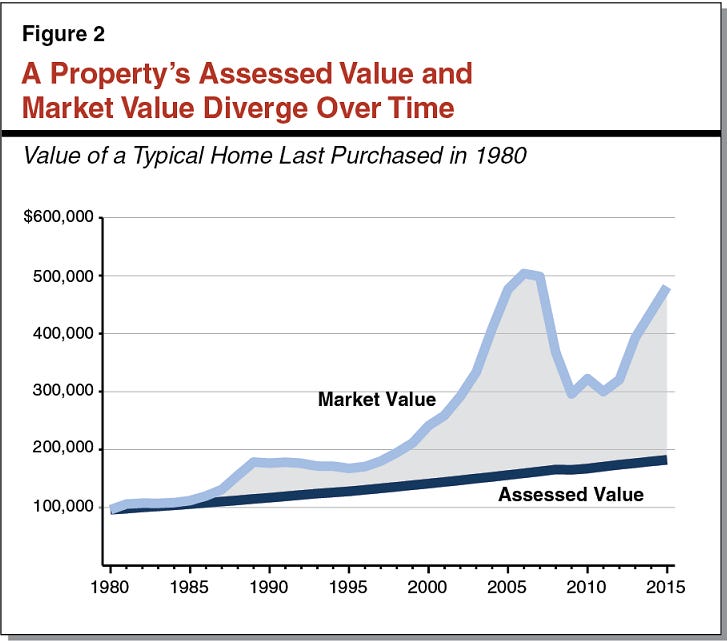
Nothing is normal in California, including how our state and local government collect taxes. In the act most likely to cause a Georgist to run screaming into the wilderness, California adopted the most regressive and anti-growth property tax system the world has ever seen. In 1978, an anti-tax crusader named Howard Jarvis convinced the voters to pass Proposition 13, which capped how much property taxes could be raised.2 As a result, homeowners — and, thanks to subsequent propositions in which homeowners flexed their political power, their children and grandchildren — have much lower property taxes than they would otherwise be expected to pay. Over time, this has meant that long-time land-owners are taxed pennies, while new buyers are the only ones paying — and therefore paying far more than their fair share.
What Prop. 13 didn’t do was change that California remained a state that wanted to offer public services. The amount of money that governments in California needed to pay for school, roads, fire-fighters, and everything else didn’t change. As a result, Prop 13 has distorted how California raises revenue, shifting the distribution of taxes to other sources, especially taxes on capital gains, sales, and income.
At the state level, For example, California has the highest individual income tax rate in the nation. While we could debate the economic or moral merits of taxing investment and earnings, what should be obvious to anyone is how volatile this makes the state finances: California’s budget booms and busts with the economy.
Another distortion that Prop. 13 introduced was at the local level. It didn’t make the budget needs of local governments go away, but it did shift how they could pay for them. (For more on impact fees, see here.)
Another example is that in 2023 Los Angeles enacted a “mansion tax” of four percent on the sale of homes valued at $5 to $10 million and five-and-a-half percent on homes above $10 million. (So if you sell a home for $5 million, you’d pay $200,000 under the tax.) The tax was intended to fund affordable housing, but may have backfired, since according to at least one study developers opted to build fewer homes and homeowners opted to avoid the tax by remodeling rather than selling.
As you can guess, the Howard Jarvis Taxpayers Association, by contrast, doesn’t like taxes, whether state ones or local ones. So, recently it began circulating an initiative that would have done two things: First, it would have limited local transfer taxes to no more than 0.11% of a property’s value. (Twenty-six cities currently have taxes above that number.) Second, it would have raised the votes required to pass citizen-initiated local taxes from a simple majority to two-thirds, and would void any local tax passed since 2017 that didn’t meet that threshold (for example, the LA mansion tax).
As YIMBYs, we don’t like real estate transfer taxes because they raise the cost of housing. They are the wrong kind of taxes. You shouldn’t tax good things you want. Housing is a good thing we want. You should tax bad things you don’t want, at least if you can. So YIMBY Action supported a different idea, AB 736, which would have simply limited transfer taxes throughout the state. We were joined by pro-housing groups, builders, and chambers of commerce throughout the state, but ultimately we didn’t succeed. That’s frustrating, although I do take some solace in the fact that the compromise proposition may not pass at all.
Regardless of all that, we don’t have a well-designed system of taxes in California. Because of Prop. 13, local governments don’t have the revenue they need, and so they have developed over generations a culture of passing fees and taxes on all and sundry, including the sale of real estate. This has been politically easy, because developers aren’t very popular.3 Historically, very few people have wanted to be on their side, except for us YIMBY idiots. They aren’t from around here, and they have a lot of money. So why not tax the shit out of them? This is bad because, of course, it holds down the production of new housing.4
Bigger picture, this isn’t a case of California being special — California is just ahead of the curve. In the last couple years, MAGA republicans in Florida, Texas, Idaho, Indiana, and Ohio have begun floating the idea of “abolishing” property taxes. And, as we know from California’s experience, this just pushes state and local governments to raise taxes on other things. And other things are almost always worse than just having a sane system of property taxation.
So that’s my bigger take. California is having this whole debate around transfer taxes because of the terrible system we created in 1978. It’s patches on patches on patches. It’s bug fixes all the way down. It’s also a preview of the future that other states will set themselves up for if they follow California’s example.
As a result of progressive-era reforms, California tends to ask its voters to weigh in on policy changes a lot, both at the state and local levels. That’s why our ballots are so long compared to most places.
More accurately: Prop. 13 says that the rate of taxation cannot exceed 1% of the assessed value, and restricts the annual increases of assessed value to an inflation factor that cannot exceed 2% per year. Critically, it also prohibits reassessment of a new base value except when ownership changes or new construction occurs. What that means is that over time as inflation rises, property taxes do not keep pace, meaning that the longer you own your home, the less taxes you pay on it
And the other really pro-housing constituency is all the people who never got to move into the housing that was never built. So by definition, they don’t vote in that locality either.
Another reason this situation is bad is that it has led to a political culture in which we often tie new revenue to particular spending. So for example, the LA mansion tax, which was supposed to be earmarked to subsidize housing. Right now, I’m a member of a Bay Area housing bond coalition, a group of very smart and dedicated people who are figuring out how to build revenue for affordable housing. I’m glad we are doing it, but it’s also frustrating, because in a perfect world, we would decouple the source of the income from what we were spending it on. The way that the money came in doesn’t matter for how you spend it. That’s not how budgeting should work. Everyone’s hands are perpetually tied.