
That Viral Photo of San Francisco NIMBYs Shows How Housing Is Winning
Hot take: The opposition to the Marina Safeway project shows everything that is right about housing in San Francisco.

You probably saw that viral picture from San Francisco Chronicle reporter Laura Waxmann showing a room full of people opposed to the construction of 848 new apartments on the site of a Safeway supermarket in San Francisco’s Marina District.
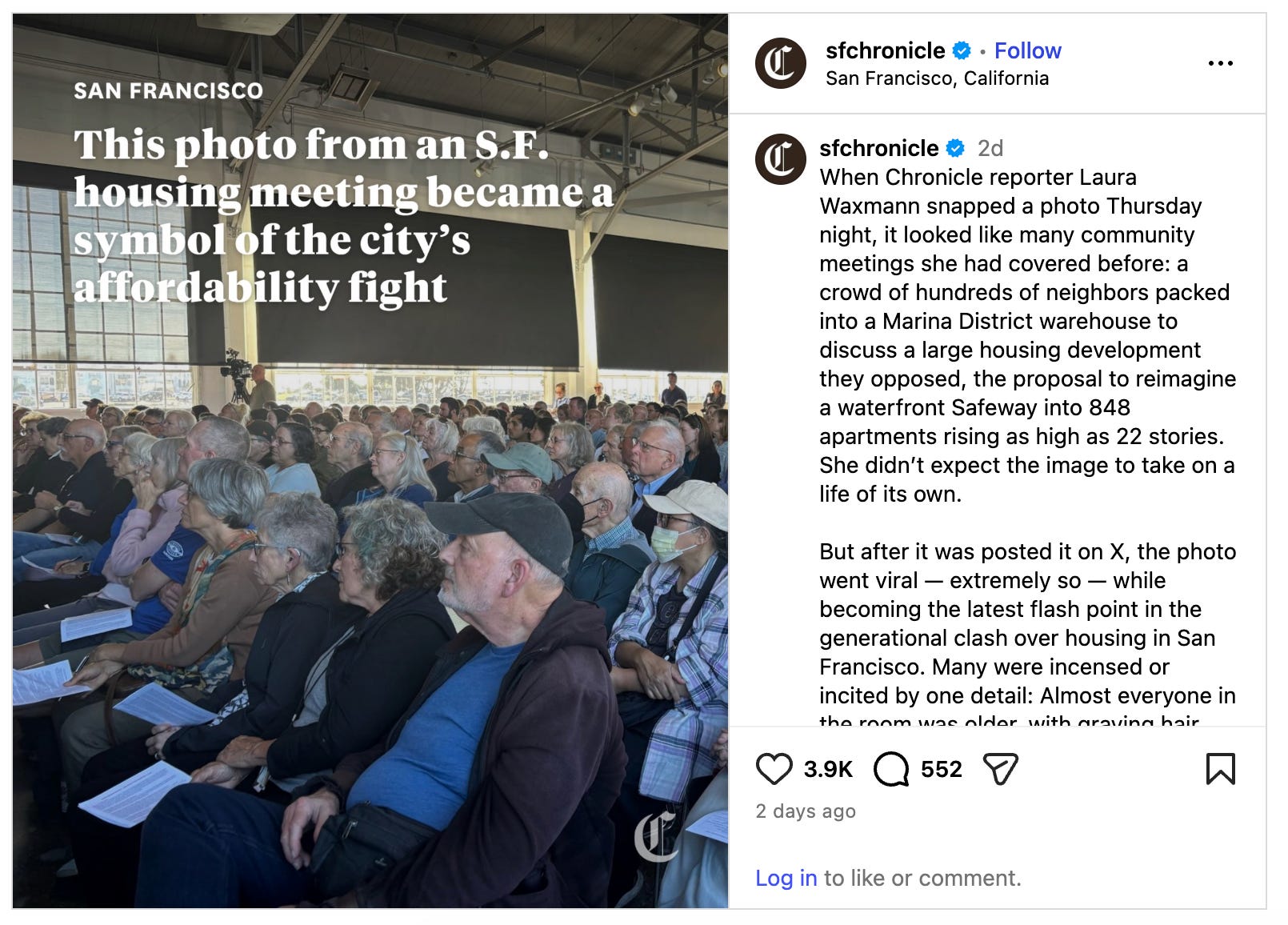
The reason that photo gained 10 million views isn’t hard to understand — it’s a perfect illustration of something we at YIMBY Action deal with all the time. Older, whiter, wealthier residents dominate public meetings, especially about proposals for new homes are in their backyards, a phenomenon well documented in books like Neighborhood Defenders.
The standard take on the internet seems to be “look how terrible everything still is and doesn’t San Francisco suck”. Even after all the work we’ve done and all the laws we’ve changed, it’s still the same NIMBYs showing up to kill housing. And I get that. After all, this photo was taken in Santa Ana in 2014, and you can’t tell me it’s not the same photo.
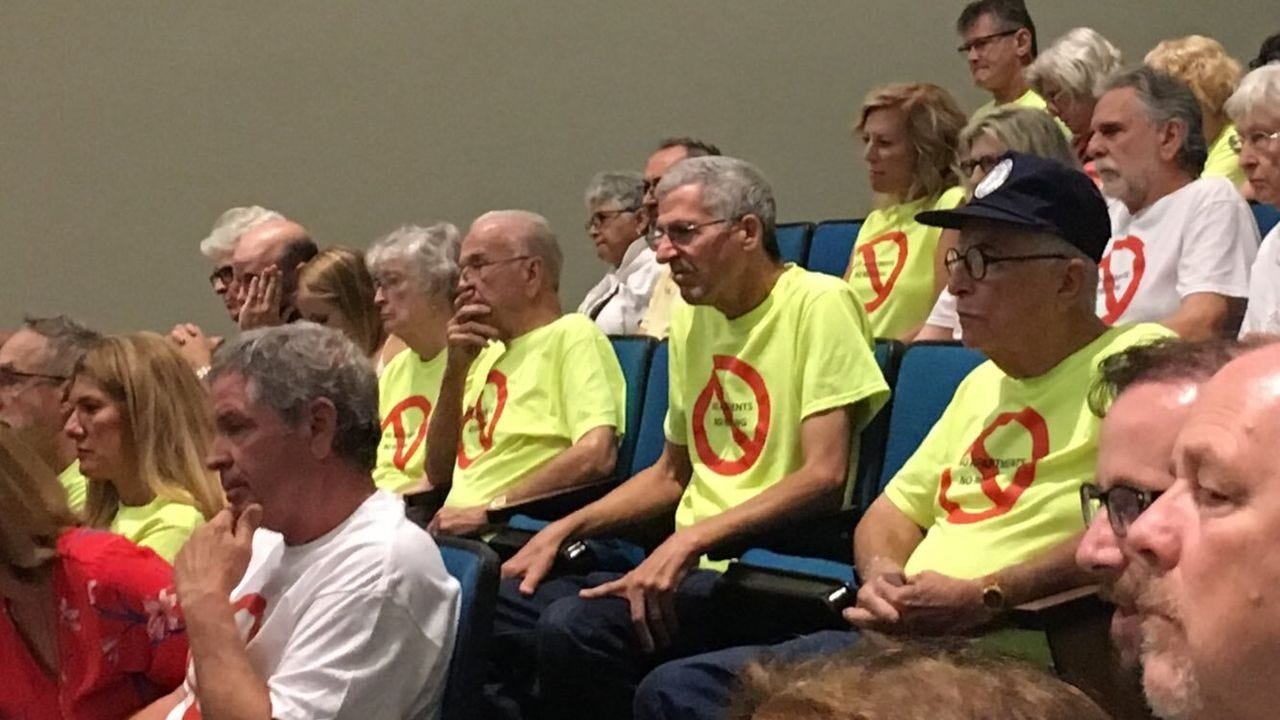
I don’t want to beat up on old people — wisdom and age go together — but opponents of new housing often skew closer to Mitch McConnell than they do AOC.1 One of YIMBYism’s big ideas is that for decades we have mistakenly prioritized the people in those photos instead of literally everyone else.
But there is a key thing that people keep missing about this photo of the Marina opponents. It was NOT taken at an official public hearing. No government agency is (officially) listening to these people! This picture is, in fact, a picture of people realizing they do not have the platform and power they once did. Thanks to California laws like AB 2011, SB 330, and the Density Bonus, this proposal is real and these people will not get the veto they are accustomed to over the Marina Safeway project.
You can see on their faces how well they are taking that — which is to say, not well at all. They wear the expressions of people who are used to getting what they want, and are angry that things may not work that way anymore.
On August 12, the San Francisco Planning Department will have to decide if that’s true. That’s the deadline for the department to determine whether the Safeway project qualifies for streamlining under AB 2011.
The law is clear, and this is supposed to be a non-political decision. But the pressure is coming anyway: NIMBYs wrote a legally dubious letter, and the Marina District’s supervisor pledged to fight this “so-called project”2 before putting his name on that absurd NIMBY plea.3 Meanwhile Mayor Daniel Lurie — boss of the department that is supposed to approve it — remains opposed. The mayor and the supervisor are taking those positions in no small part because every single person in that photo is someone capable of hosting a house party for an elected official — they all have time, energy, money, and access that, for instance, a young person in the Bayview might not have.
On the other hand, there is (finally) a loud, visible, vocal group of pro-housing voters. YIMBYs have got some excellent quotes in the papers and online.4 There’s even some polling that indicates the project is popular, as housing tends to be. And YIMBY Law has sent the city a formal letter reminding them that we will, in fact, sue if they pull some nonsense.
If the city follows the law, the Planning Department will announce by August 11th that the project qualifies under AB 2011 for streamlined approvals. The NIMBYs may sue, but they don’t have much to go on, and — faster than ever before — the project will get built. If not, well, see that letter that YIMBY Law sent that I mentioned above.
It is a truth universally acknowledged that a good bill passed in a state legislature will be attacked upon implementation.
This is the revolution that YIMBYs are orchestrating. Before this revolution, this project would never have been proposed. Now? In one of the wealthiest neighborhoods in one of the wealthiest cities, a 25-story building is on the verge of being permitted over the objections of some of the city’s most politically influential people. Booyah.
Recently, the pundits Matthew Yglesias and Jerusalem Demsas were riffing5 about whether America was in fact an oligarchy or not on The Argument podcast, and the basic summary was that it’s not technically an oligarchy if mediumly wealthy people who care a lot get their way most of the time.
Oligarchy or not, we all agree that it fucking sucks. And in less than two weeks, here in San Francisco, it might suck slightly less. I’m going to call that a win. NIMBYs are going to keep organizing to try to claw back our progress. And it’s up to us to keep outworking them.
Obscure community meetings used to be where housing went to die. Now they aren’t. I hate to be a bitch, but this is what democracy looks like.
Not all insects are crickets, but all crickets are insects. Not all old people are NIMBYs, but pretty much all NIMBYs are old.
Apparently, Supervisor Sherill believed it was a fake project meant to be a starting point for negotiations instead of an actual development that actual people would build. Whoops!
His argument is that the law requires a certain percentage of the surrounding area to be for urban use, and that parks are in fact not an “urban use.” My park-loving, urbanite toddlers would beg to disagree.
For example, Brandon Powell, Bay Area organizing director for YIMBY Action, said it was “disappointing to see a supervisor who understands the depth of San Francisco’s housing crisis dig in his heels in opposition to a wonderful project which will provide homes for hundreds of current and future San Franciscans, including 86 affordable units [...] We need not only this project but many more like it.”
Demsas summarized: “When I consider the structure of power in American politics, it often cleaves along lines that have nothing to do with being a billionaire. Homeowners dominate land use politics, professional associations capture licensing rules, industry representatives shape low-salience regulations on their issues because few other people care enough to engage. All of this can produce profoundly unequal outcomes without being the work of a coherent oligarchic class.”