
Passing the 21st Century ROAD to Housing Act
An Intro to Legislative Coalitions

The 21st Century ROAD to Housing Act is the most significant piece of housing legislation considered by Congress in decades. And after several rounds of tense negotiations, an improved version of the bill passed the House by a 396-13 vote. It now heads back to the Senate, which will need to sign off on the changes, before it goes to President Donald Trump to sign into law.
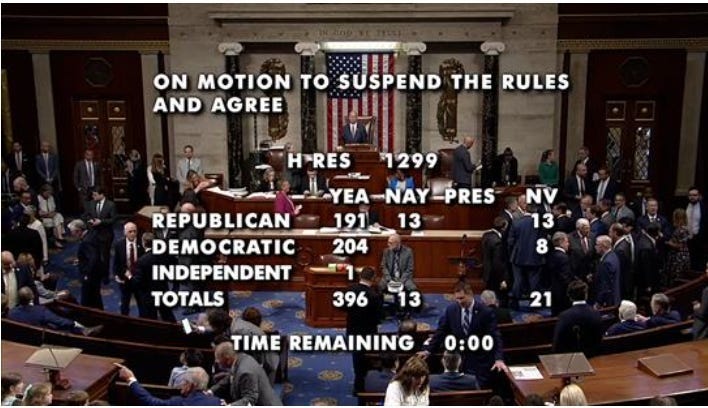
Politico is declaring victory, but House and Senate leadership are continuing to argue about some of the details to get it through the Senate. There’s good reason to be optimistic about this bill passing (you can read a rundown of the negotiations and politics on Slow Boring), but it has to pass soon if it’s going to become law.
The biggest risk is that these negotiations end up in endless arguments and nothing passes before the August recess, so it’s time to put some general heat on Senators to pass this thing.
This is where I remind you to call your Senator or use our emailer to reach out. Right now. Stop reading and go do that.
Over the past few months YIMBYs have put in significant work lobbying for the ROAD Act. So it’s a good opportunity to review: what do groups like YIMBY Action actually do to get legislation passed? What do other people do? Why does anything happen?
Legislation usually doesn't pass because a single organization pushes for it. It passes because different organizations play different roles and coordinate effectively, leaning into their strengths to form a strong coalition.
YIMBY Action focuses on “grassroots activism” a.k.a. the outside-game. Our strategy is to create a visible voting bloc big enough that officials to care. The outside-game toolkit focuses on making constituent preferences felt, whether that’s through email, phone calls, or meetings with legislators. Our job is to make elected officials feel that people in their districts give a shit about this stuff.
The outside-game is best coupled with organizations that focus on the inside-game. This is the process of walking the halls of power, having one-on-ones with legislators, and mapping out how everyone is going to vote and what it would take to flip them if necessary. The inside-game toolkit focuses on being physically in the Capitol, often by hiring lobbyists, meeting with legislators, distributing fact sheets, and getting a sense for who legislators need to hear from in order to move on an issue.
Each strategy has its strengths and weaknesses, and passing legislation typically requires both.
Outside-game organizing benefits from the information generated by inside-game coalition partners. They help answer questions like: "When is the best time to mobilize supporters?" or "Which talking points are most likely to resonate with a particular legislator right now?" The outside game is about building political pressure; inside-game partners help us understand when, where, and how that pressure can be most effective.
For its part, the inside game has its own blind spots. When you're spending all day talking to legislators and staff, politics can start to look like a puzzle of relationships, negotiations, and vote counts. But elected officials ultimately care about what their constituents want — or at least what they think their constituents want. Effective outside-game organizing can change those perceptions and the political calculations that drive inside game negotiations. If you can mobilize enough home district support, you can just change what an elected wants.
A great coalition brings these two strategies together. It coordinates the information of the insiders with the resources of the outsiders. It ensures that mobilizations and other touchpoints happen at the right moments, creating maximum pressure on officials to vote our way.1
Coalition work is always a bit messy, but it produces results. Not only has the ROAD Act advanced with overwhelming votes, the House has also stripped out a harmful provision that would have required institutional investors of build-to-rent single-family homes to sell those properties within seven years.
One place where the two strategies come together is letters of support, which are formal statements of support (or opposition) for a bill, signal who is coordinating with whom, and highlight which parts of the legislation folks care most about.
The most recent letter of support for this bill was coordinated by Up For Growth, and included signatures from companies like Airbnb, professional associations like the American Planning Association and the National Association of Home Builders, and think tanks like the Niskanen Center. It made waves, not because of what it said but because of who was saying it.2
What I want to highlight are the dozens of state and local YIMBY organizations that signed on, too. About 80 of these signers are YIMBY Action chapters, who have been working hard in their districts advocating for housing and building local power. This chapter model is critical because it means we can assemble like Voltron at moments like these to demonstrate support for housing reform.
Building out our chapter system and having all those individual chapters sign on to letters shows individual Congresspeople that the citizens they represent want progress on housing. This is why you — YES YOU — should start a chapter! Even three people in a town in literally anywhere can have a huge impact by creating a local chapter and being part of a network that activates for state and federal legislation.
Now that you’ve eaten your broccoli and fully understand the mechanics of passing legislation (and been convinced to start a YIMBY Action chapter), I want to make one last comment on passing legislation.
So far in this conversation, we’ve been talking about the how. I also want to say something about the why.
I recently listened to Ezra Klein’s recap of the Abundance movement a year after writing his book with Derek Thompson. Suffice it to say, Klein was a little melancholy. Talking about state-level housing legislation in California, he said:
There has been a decade of housing bills being passed in California. Dozens and dozens of bills, including many that were framed to me as transformative, just weren’t [...] A lot of things don’t work in practice the way you think they would.
Argue with me, but I think this is a bad take.
Can a bill — either state or federal — be “transformative”? Not in the way that Klein means. But it will be huge!
We have to live with the cognitive dissonance that (1) the ROAD Act is the most ambitious piece of federal housing legislation in living memory, and (2) it will not fix the housing crisis on its own. We shouldn’t expect it to. There is no single piece or even a package of legislation that will fix our broken housing system overnight.
Ultimately, the ROAD Act matters not only because of the policies it contains, but because it helps establish housing affordability as a federal concern. We have gone from a world where the default was “local control of land use is sacrosanct,” to “state governments need to do something about their housing shortages.” The ROAD Act will help take us from there to, “the Federal Government acknowledges it is deeply alarmed about housing affordability in America.”
Legislation is not an endpoint, it’s just a stop along the way. That doesn’t mean I’m not excited about major reforms like the ROAD Act, it just means I’m excited about them for the right reasons (and it also means I’m not disappointed when we pass something and still have miles left to go).
Alright, now go contact your Senator and tell them to support the 21st Century ROAD to Housing Act.
Minor clarification in case I’m making this sound more straightforward than it is. Different organizations can play different roles at different times. Sometimes YIMBY Action staff or chapter leaders pay the inside game role, though the work on the ROAD Act is currently led by Up For Growth. In the same vein, there can be more than one coalition working to pass a bill; in this instance, the National Housing Conference is convening an industry group that’s also in support of the bill.
I want to emphasize this a bit because YIMBYs (like most folks in politics) can get really hung up on crafting the perfect message. I’m not saying that messaging doesn’t matter, but just as much work needs to be spend on gathering messengers. To a legislator, it’s less important how exactly a constituent talks about supporting or opposing a bill. The amount of support or opposition, by contrast, matters a lot.